Recent update: for my publications on handling aortic disease, and getting back in shape safely, go to this link. YOU HAVE A SMALL ABDOMINAL AORTIC ANEURYSM - SEE THIS BLOG POST.

An Inspiring Book by An Inspiring Guy. From : http://goo.gl/lePdB
The subject of exercise following corrective surgery is a tricky one, and your best chances of success need you to be intellectually and emotionally involved in the process. Remember, an active body is a strong body, and that includes your aorta, defective or not.
Having undergone stent placement for a large abdominal aortic aneurysm (AAA), I have become involved in the aortic aneurysm and dissection community. It turns out that there are quite a lot of us, some of whom can be found at the AAA Awareness Facebook site. Locating the appropriate support group is critical when dealing with life-threatening medical situations, but it is not always easy to find them. As I have been blogging on the issue of safe exercise for better health for about one year, with special reference to health challenges based on my own experience, people write to me from time to time to request advice. The other day I was asked for guidance by someone who is two-years post-surgery, for correction of an aortic dissection. Here are my initial thoughts.
- Study the condition and understand it in as much detail as possible, including all potential effects of treatment and the risks associated with such treatment. Here is a nice, succinct review of aortic dissection published via PubMed. If you don’t have a medical background you may be overwhelmed by the available data and opinion or even ‘taken in’ by misinformation, in which case it might help to find someone who does have such training, and preferably a someone who has the time to devote to your case.
- Write down everything that happened, including all symptoms and other observations concerning your health as it might relate to your aortic condition. I kept such records on this blog, which resulted in a valuable online data set concerning my stent-induced hypertension (FDA adverse event report filed) that was finally corrected with exercise combined with an ACE inhibitor.
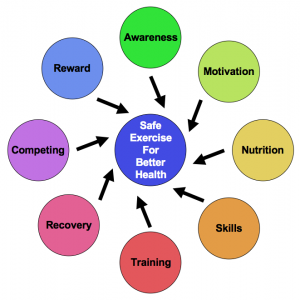
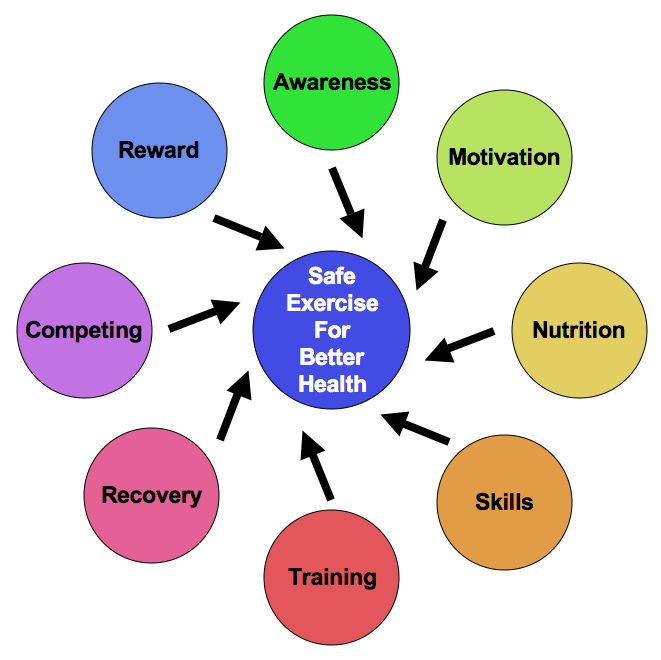
For safe exercise, use the FitOldDog Training Wheel, starting at the top and moving clockwise, with red for danger! Safe exercise for better health is my mantra.
- Explore the literature for the probable outcome (prognosis) for your condition, including any medical or surgical corrections undertaken. Try especially hard to discover any risk factors. For instance, in my case the risk factors for potentially lethal displacement of my AAA-stent graft included intense rowing, use of a lap belt in a car wreck, or a Heimlich maneuver (can’t avoid that one, for obvious reasons, so I eat carefully!).
- It is critical to obtain the guidance of your surgeon (and other medical personel), as he/she is the only one who really knows what went on as your aorta was repaired. He/she is the person who really has the best insight (not certain knowledge) into what might and might not breakdown under stress. That said, remember that you are the master of your body and you get to decide which advice to follow and which to ignore, but do so intelligently, using both reason and emotional intelligence.
- When it comes to communicating effectively with your doctor or surgeon, I recommend that you read ‘Your Medical Mind,’ which I reviewed previously. The real trick is to avoid stressing your surgical site unduly, especially early on. I was very careful for the first six months, as I didn’t want to move my stent, and then one year later I completed the Lake Placid Ironman. I did it carefully and relatively slowly but without incident.
- You have to know what you are doing when you start to really train, and if you decide to do so find a coach who understands your condition, as I did with Eric Bean, who trained me for my first season post-surgery. Eric is an MD with a background in Biomechanics, who put my mind at rest about the risks of metal fatigue in my stent graft during high cadence endurance cycling - it worried me a lot before talking to Eric. My thoughts on this issue, and the critical nature of body awareness, balance, flexibility and core strength are laid out throughout this blog. I have attempted to encapsulate my experience in The FitOldDog Training Wheel.
- Find out what other people have done in your situation, and talk to them. In the case of an aortic ‘prosthesis’ (Dacron insert), just read the story of Benjamin Carey in his book, ‘Barefoot in November,’ and contact him directly via his blog.
- I would recommend that you start with simple body awareness exercises, including meditation, so that you can ‘hear’ the warning signs, then explore balance, core strength and flexibility. Gradually progress to long walks, eliptical trainers, guided weight training (but choose your exercises wisely) and swimming, as they are essentially non-impact sports. Remember that if you bike or run you risk a fall (not a good idea), which is why balance, core strength and appropriate skills are so important for such activities. The repeated impact of running might be a risk factor, though Benjamin (and his surgeon) did fine at the New York Marathon one year after the surgery (see video clip below)
- I strongly recommend that you combine your exercise with the study of techniques designed to improve body-awareness, such as Feldenkrais. It has worked for me, anyway.
- Find people to talk to and tell your story on appropriate websites, such as Brian Tinsley’s Aortic Dissection Blog. You might be surprised by the number of people out there in Cyberspace who will give you support and useful input.
- Don’t give up, don’t hesitate to ask for more information, and use the inspiration of others to keep you going on difficult days, as in the movie clip below. I do, and it helps a lot. Before you know it you’ll be inspiring others in your situation.
These are my initial thoughts. It is up to each of us to create our life and as Pauline’s surgeon advised, “Don’t become a prisoner to your aneurysm [dissection].”


Hi, I’m almost 39 yrs old male (39 in aug) :). On 4th of apr 2012 i had an accute MI & rushed to hospital where i underwent through “Primary PTCA” and two stents were deployed to RCA & one stent to LCX. I’m now on 3 weeks bed rest. I live in Bangladesh where the rehab facilities or advices are not available for angioplasty patients. So i have absolutely no clue that what’s next for me. I love playing tennis and squash. Can i ever play these games. What exercises should i do now and for how long etc.
I’ll really appreciate your help as i’m very frustrated from lack of directions from my cardiologist.
Hi Saqib,
Sorry to hear what you are going through, but with the right approach you should be able to get on with your life fine. Remember that you have to make this work for yourself, but there is a lot of advice, information, and others with the same problem out there. You are young, which will help a lot. I would recommend that you go to the Angioplasty.org (http://www.angioplasty.org/) and Cardiac Athlete (http://www.cardiacathletes.com/) sites (under the ‘Useful Links’ tab on this blog), to talk to others about your situation. I would also recommend that you read my blog post that I wrote for a lady who was recovered from aortic dissection (a much more dangerous condition) for a general strategy (http://goo.gl/KjtgI). Then we can talk via this blog, if that would help. The trick is to understand your condition, make a plan, get started, make changes slowly, and NEVER EVER GIVE UP. You have short-term (getting moving safely) and long-term (fixing nutrition, and whatever else caused the problem - exercise helps with genetic liability, as in my case) issues to deal with. Let me know that you received this, and then I’ll put in a little more thinking about it issue.
I have yet to receive much useful advice, apart from the ‘party line,’ from cardiologists. They do save our lives with stents and stuff, but then it is up to us to make it work.
You’ll be fine if you believe in yourself, my friend.
-kevin aka @FitOldDog
This is a tremendous site! I am so amazed at the quality of this information and the incredible miracle survivor that Kevin has become. He is truly an inspirational and motivational person to learn and grow from. I know I personally play competitive tennis still as it was on the tennis court during a match that I had my dissection. And then off to the ER for emergency open heart surgery and I too got a miracle and second chance at life. There is so much to life and there’s nothing stopping Kevin here. Wow… he’s in tremendous shape and a wonderful wealth of information. I hope that you can also swing by http://www.aorticdissection.com and read other stories about this Aortic Dissection disease. Keep up the great work Kevin! It’s super!
Hi Brian,
thanks for the encouragement. I’m looking forward to your invited post, which makes two in the works, and that’s great. Glad to hear that you still play tennis. I need to go read your story, which I guess must be number one on your site.
You are doing a great job of drawing attention to aortic dissection and it’s issues, by the way, so thanks for doing that.
Cheers,
Kevin aka FitOldDog
I am 25 years old and just underwent emergent corrective surgery for an aortic aneurysm and dissection. Aneurysm had been dilated to just under 5.5cm. I am nearly exactly a month out from surgery. Before surgery I was a climber and training very hard to take on large prizes in alpine style. I am getting stronger and will work as hard as I need to to get back into the shape I was in and excel in climbing. I am wondering if anyone has any experience with these procedures and their affects on climbers or in the realm of training in general, especially heavy weight training, cross fit and regaining aerobic endurance.
Thanks all,
Steve
Hi Steve, before you do anything, study body awareness, then you’ll be able to proceed effectively without killing yourself. Make sure you fully understand your surgery and GIVE IT TIME TO HEAL. You have your whole life ahead of you, and now is the time to be cautious and sensible. You’ll be back climbing safely and well, but not immediately. You may even climb better (I couldn’t do it, would scare me to death). You have to be patient. I hear of people who had dissection surgery years ago and are doing well, even competing in mountain bike races. These are the people you need to find and talk to. I’m off to see my bike guy now, as I prepare for Los Cabos Ironman (finally over the damned flu). I’ll write more soon, and give you the link to our awareness video set, if you are interested. Awareness keeps me safe and training, but I only have an AAA stent graft. Please be patient at this stage. One month is not a lot of time for healing. Get some idea of the fragility of the repair from your surgery team. Pepper them with questions. What is your medical training? Make a careful recovery plan. Don’t do squats or rowing machine at this stage. Will be back in touch this afternoon. Kind Regards, Kevin
A wwek ago I had 2 of 3 walls of my aorta tear when I was life flighted to wospital whitch was top notch for corrective heart care I was told that I had 25% chance of survival. Well I made it and was lifting heavy before the incident. I was wondering what exercises with the weights and how heavy I can do.
Hi Big Dog Sam, if you dissected a week ago, I’m surprised you are writing already. Congrats on your survival. I wouldn’t even think about exercise until everything was stable. You can pose questions about dissection on various forums, including the AAA Awareness page, https://www.facebook.com/groups/2283898552/ . You need to VERY CAREFULLY follow the advice of your health professionals until your aorta is stable. I have discussed all of the general issues about getting one’s life back on track in my recent e-book, which is linked on the main blog page. You can get back into great shape, but if you go too fast you won’t be in any shape at all. Take your time, as frustrating as that might be. You are dealing with a major and dangerous plumbing issue. Wishing you well, stay in touch, and be careful because life is too precious to waste. Kind Regards, Kevin Morgan aka FitOldDog
just,just, found the page….gotta say…ive only read a few comments and I’m excited. 30 days out of an emergency 8 hour op ascending, will be going back for a stent in the lower section asap. still totally new, just starting to look it up and to understand it all.. i was starting to get worried i couldn’t get back to my 200km per week riding/ my fitness. as i always said and believed i would be strong again so i will be spending a great deal of time reading…it gives me a great feeling to a post aortic dissection life
Hi Ben,
If you’re in Australia, they sure know about aortic disease treatments. In fact, my recent stent repair involved an extension built in Australia. Glad to hear you are up beat. There are several great Facebook support sites for aortic aneurysms, where you can talk to people about your situation. If I can help, let me know, and take your time getting back on track.
I’m still training for Ironman, and now 5+ years out from my AAA stent graft placement.
Kind Regards,
Kevin aka FitOldDog
PS Sorry for the delayed reply, I was in Kona watching my son the Hawaii Ironman.
I am so happy to come across this site. I am a 5 year survivor from a traumatic thoracic aneurysm - I had an abdominal stent graft placed. I exercise often but I find when I jog I tend to get sharp sternal pains in the days following. Eventually they subside but I keep wondering if the jogging is causing this. Anyone else experience this?
Hi Michelle,
I apologize for the delayed reply. I’ve been elsewhere. Sometimes, I have too many balls in the air. I would experiment to find the cause of the pain. For instance, try water running to see if the same thing happens. If it’s due to impact stress, and water running doesn’t evoke the pain, you have your answer. I would then work on low impact running style. I’ve only had an AAA, no thoracic involvement, but I’ve had my own issues. There are several great Facebook sites to pose your question, such as the AAA Awareness Group, that I use quite a bit, at:
https://www.facebook.com/groups/2283898552/
Let me know if you need more input, and I’ll try to keep an eye open for your response.
Kind Regards,
Kevin