It seems that the older I get the more my feet ache in the mornings, and much of this can be traced to tight calves and hamstrings, in my case at least.
You could develop flat feet (collapsed arches), if you give into the constant pull of gravity, but your normally springy arches are designed to protect your body from jarring impacts and to facilitate effective walking and running. So, look after your arches.
Here are my major running support systems, including rollers and different types of running shoes. Different tools for different jobs. Photo by FitOldDog.
I don’t have flat feet, except when my arches just can’t go the distance on a long run after a hard bike ride. My calves, and other arch support systems, are shot, so I have to take great care to select the right shoes. I love to run in minimalist shoes (Nike Frees), but as the distance increases I can feel my arches failing. My feet actually feel flat, slapping the ground in a kind of collapse. Thus, for intermediate distances I’ll use regular running shoes (Brooks Glycerin), with lots of support, including arch supports (Superfeet). For my longest races, Ironman-distance triathlons, I’ve moved to Hoka One Ones, which do a lot of the work for my feet, IF I remember to relax.
Flat feet can open you up to the risk of plantar fasciitis, as in the case of one of our customers, Rosemary. You can read her story at this link, and we fixed her problem with our Activate Your Arches Video.
And then there’s soft feet! My first introduction to the concept of soft feet was when I read that excellent running book by Jack Heggie, ‘Running With Your Whole Body: Your Guide To Running Faster And Farther, With Less Effort And Pain.’
Then I thought, “Well, if I can have soft feet, what are hard feet?”
I think I’ve worked it out, as a direct result of my recent experiences with a tight calf, and then plantar fasciitis, both of which are close to being fixed. If the muscles in your feet (I believe there are 19 in each foot), and those that work your arches, are tight, and the fascia of your lower legs is constricted, your feet won’t mold with the ground as you walk or run. They will literally fight the ground, which could lead to increased local impact stresses, resulting in blisters and strains.
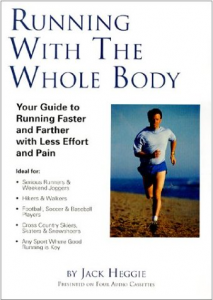
‘Running With The Whole Body.’ Follow the exercises in this book with care and you will learn a great deal about effective running.
My feet do feel hard when I am suffering from tight calves, with or without associated plantar fasciitis, and the hard spots seem to migrate around my heels and the soles of my feet. Then I do a short roller and stretching session, combined with the exercises in Jack Heggie’s book, and my feet feel lovely and soft again.
The key is to train and strengthen your feet to work with the ground, or be well grounded, but this takes a skilled approach to both walking and running. If you really challenge your feet, as I do during Ironman training, you have to go the extra mile and apply regular stretching, myofascial massage with rollers, hands, or a tennis ball, or seek assistance from professionals.
Fix tightness before it becomes an injury, whatever you do!
One of my massage therapists hit the nail on the head when she said, “Kevin, underneath tightness lies weakness.” This is why strength training in the gym is a critical part of my winter training program.
Walking or running on soft feet on trails or the track feel so good, but it takes a little work and strong, responsive arches!
Cheers,
Kevin aka FitOldDog
PS I really recommend Jack Heggie’s book, which is Feldenkrais-based, and contains some remarkable lessons for the runner who wants to run safely into their later years.
Important Note: These posts do not provide medical advice. You should always consult your physician before undertaking or significantly modifying an exercise program.
Copyright © 2010 Kevin T. Morgan aka FitOldDog, Old Dogs in Training, LLC.
Related Posts
- 36Hi folks, welcome! We need tools to assist with weak areas of our bodies, but once the issue is corrected beware turning a tool into a crutch. In the process of providing advice (not medical advice!) to a customer suffering from plantar fasciitis related to weak arches, I agreed to write a blog post on…
- 35Hi Folks, I'm pleased that you took the time to visit! Whether you walk, run, bike, swim, ski, or whatever, happy feet are one key to a happy you. The way to develop happy feet is to (a) build strong, active, responsive arches, (b) develop soft feet, as recommended by Jack Heggie in one of…
- 34Hi folks, I must admit that I find running challenging to say the least, especially long runs such as my coach proscribed 16-miler in the Hawaii heat yesterday afternoon. As I approach taper for the Lake Placid Ironman, my workouts become increasingly long, but this year I feel stronger than in 2011, so we'll…
- 30Hi folks, welcome! As fear seems to be playing an unnecessarily powerful role in my life, and potentially my decision-making, I thought it germane to read the book by Germain, so I downloaded it to my Nook. I was struck by one sentence in the synopsis, "Fear makes us stupid." I wondered, is this true?…
- 30Hi folks, welcome! It's a funny thing being the oldest person in a race. You win your age group because you're the only one in it, and it feels like getting a medal for being the last one left alive in the nursing home. But the real message is, "As you get older you slow…


Speak Your Mind