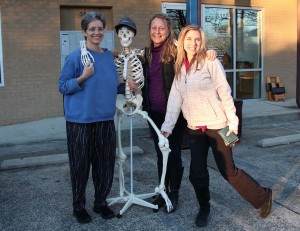
FitOldDog has learned a lot from his wonderful body movement teachers. Left to right: Karen, Feldenkrais; Mr. Bones, Anatomy; Rebecca, Continuum; Tara, Gyrokinesis. Photo by FitOldDog, with permission.
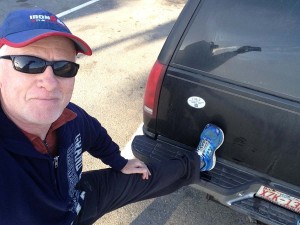
The rear bumper of my old truck provides the perfect hamstring stretch platform during long road trips.
“Men are born soft and supple;
dead, they are stiff and hard.
Plats are born tender and pliant;
dead, they are brittle and dry.
Thus whoever is stiff and inflexible
is a disciple of death.
Whoever is soft and yielding
is a disciple of life.
The hard and stiff will be broken.
The soft and supple will prevail.”
From the Tao te Ching, Lao-tzu (about 300-400 BCE), translated by Steven Mitchell.
Mastering the art of stretching will help your old age, and I agree with Todd Hargrove, in that it is best to think of stretching as neuromuscular retraining or reprogramming, rather than ‘wrenching muscles to be longer.’
There really is an art of stretching. Not too much and not too little is the key. If in doubt, err on the side of a more gentle pull. With practice, you will know when to stop.
Get the stretch right, and you’ll feel a pleasant buzzing sensation, like a violin string vibrating in response to a gentle touch.

Try to stay well hydrated as you age, it helps flexibility. Click image for source page.
A critical aspect of maintaining an active life-style into later old age is the work needed to stay limber. Tight tissues are easily torn. This becomes increasingly difficult as the drying of our tissues sets in. Plenty of hydration, and a more hydrating diet (see comment at end of page), may delay these effects, but we become much stiffer with age, especially if we don’t work on it regularly, which means every day.
When you undertake a stretching routine, it is essential that you stay very aware of your body. Watch how it is responding to the stretch, in order to titrate it optimally. By the way, body awareness simply involves learning to watch, listen to, and read your body as you undertake different activities.
I prefer the term lengthening, to stretching, as taught to me by Karen Dold, my Feldenkrais instructor, though the term stretching is in general use, so I’ll stick to it for now. I like to undertake the process very gently. If you stretch too much, you simply trigger reflexes that will contract the very muscle groups that you are trying to relax. You can aid the lengthening process by contracting the opposing muscle groups - for instance, contract your quads when attempting to lengthen your hamstrings. Then relax them, and feel the difference, as both are useful.
You could consider studying Continuum, as I have for some time with Rebecca Amis Lawson. This technique involves harnessing vibrations of self-created sound, and targeted tissue resonance, which is used to render connective tissues more fluid during a stretch (it works!). Here’s a brief extract from my first Continuum lesson:
Finally, my studies of Gyrokinesis, with Tara House, taught me a critical aspect of lengthening my hamstrings - stick out your chest, as if embracing the sun, for a more controlled and focused hamstring stretch.
 I highly recommend that you consider combining body awareness with your neuromuscular (maybe neuromyofascial) lengthening routines, as your body will appreciate it and your movements will become relaxed and fluid.
PS - when I was searching for nutrients that help one stay hydrated, I could only find articles on foods that contain a lot of water - surely there are nutrients that would favor the synthesis of proteins and other macromolecules that tend to hold water in connective tissue in a beneficial way - if you find any information on this issue, please send it my way before I desiccate and blow away in the wind.
Important Note: These posts do not provide medical advice. You should always consult your physician before undertaking or significantly modifying an exercise program.
Copyright © 2010 Kevin T. Morgan aka FitOldDog, Old Dogs in Training, LLC.
Related Posts
- 54Hi folks, welcome! If you are having a hard time finding inspiration to help you cope with aging, remember that there are always others who have overcome greater adversity into later life, and with a smile. Along with aging, can come a feeling of increased separation from the mainstream of society, but it can be…
- 44Hi folks! Thanks for stopping by! We recently held a body awareness workshop ('Run Smarter'), in which I got to witness people saying, "Oh! Yes! That feels completely different." The one-day class was designed to help people move more easily and efficiently through improved understanding of how their bodies move and feel. There was some…
- 37There is no doubt about the fact that aging is stressful, and developing the tools to deal with it, such as meditation, and a good network of friends and family, can transform a living hell into a delightful life. When I discovered meditation, years ago, I realized that I could calm my mind when needed,…
- 34You can exercise to look younger, I've noticed, as I continue Ironman training into my 70s. It works best, Deb tells me, when I keep my hat on to hide my white, yes, white, not grey, hair. Exercise-induced youthfulness comes with many benefits, especially when you need to attract a good mate, and keep them.…
- 31"Body-awareness isn't about knowing how your body works, which can never be complete, it is about CARING about learning about how your body works." Quote from FitOldDog. Hi folks, I'm sure that you have read stories about great hunters who are completely aware of their surroundings. Of course, they have to deal with their prey…



Speak Your Mind