Stand in the center of the circle, spin around, and you see all those treatment choices. Our goal is to simplify this process. If you are interested, go to this link to see some plantar fasciitis journeys, mapped on this diagram. To understand a disease you need to study it and look for patterns - that’s what we are doing. All data appreciated. OK! On we go!
FitOldDog’s Current Working Hypothesis for the underlying mechanisms of plantar fasciitis foot/heel pain (YOUR JOB: TO SHOOT IT DOWN):
- Modified activity (overtraining, different shoes, walking on sand a lot, etc.) ->
- failure of adaptive neuro-bio-mechanics ->
- dysfunction of myoneural(fascial?) reflexes ->
- dyskinesia -> dysfunction stress on motor systems of the lower limb during activity ->
- stresses on connective tissues of the system ->
- pain response (warning) + (if severe) bone spurs, microtears, plantar fascial ripping ->
- severe motor dysfunction and no fun running (bummer)
dys·ki·ne·siaˌdiskiˈnēZH(ē)ə,disˌkīˈnēZH(ē)ə/nounMEDICINE
-
abnormality or impairment of voluntary movement.
-
Note: find flaws based on data (verified observation) and I’ll work on it.
We need: neurokinesiologists to work on this, to find a set of optimal corrective training movements.
[ASIDE} ? Why do calf raises help? Training weak muscles? Unlikely, PF happens in very fit people. Probably retraining myo-neural reflexes.
————————————————————————————————————————-

For our FREE plantar fasciitis research newsletter. You can unsubscribe at any time.

A displaced pelvis ruined this race and led to my second, and worst case of plantar fasciitis. Fixed it!
The material referred to on this page, in part at least, provides the basis for FitOldDog’s Plantar Fasciitis Roadmap (coming out soon in eBook format).
[PS *** = where I left off the work; got to have a life!]
The map is designed to help people down the road to a cure, as economically as possible, providing recommended directions to take based on symptoms and responses to treatment. The authors research this subject regularly, and once the book is published the roadmap is sure to change as new understanding and treatments are developed.
This means that to be of value the roadmap should be dynamic, responding to new knowledge as it arrives. You will need a password for access to our dynamic roadmap, which will be mailed to all who purchase our roadmap ebook.
Please be patient, it’s coming out soon, so on with building this FAQ page, which will also be a dynamic process, just like plantar fasciitis!
-ooOoo-
Frequently Asked Questions
What is plantar fasciitis?
FitOldDog’s Response: The only thing that is really known for sure about this condition, is that it involves pain in the feet, especially the heels. This pain is generally most severe as you move following prolonged inactivity, such as sleeping in bed or sitting, and it can last a few days to even years. Some cases are readily resolved with a little rest and massage, and others are almost completely resistant to treatment. Plantar fasciitis is also considered to be a precursor to heel spurs, and may even lead to tearing of the plantar fascia, requiring surgical repair.
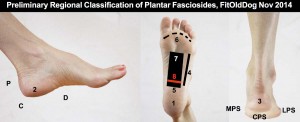
FitOldDog’s Plantar Fasciitis Distribution Map
How can I be sure I actually have plantar fasciitis, and not something else? A number of other conditions can induce pain in the heels, and elsewhere in the feet, including:
- Damage to the Achilles tendon
- Tarsal tunnel syndrome
- Heel bruising with local inflammation
- Strained ligaments or tendons
- Stress fracture
- See our Plantar Fasciitis Newsletter for a growing list.
Morning stiffness, especially with aging, can exacerbate pain associated with such conditions, and mislead you to an incorrect diagnosis of plantar fasciitis. If in doubt, seek expert advice, from a Physical Therapist of Sport Medicine Physician.
How can I fix my plantar fasciitis?
I fixed my first case of plantar fasciitis with the aid of a TriggerPoint Therapy Performance Roller, but the second attack was more complicated, interesting, educational and painful!
FitOldDog’s response: this is a doozy of a question, and it is the purpose of our work, publications and thinking. Having suffered two cases, once relatively easy to fix, once I was introduced to rollers (see blog post at this link), the other, several years later, and really tough to fix. These two cases were completely different, and you have to find out what kind of plantar fasciitis you have.
Let’s consider your options, one by one, in the order that they appear in a Google search for ‘plantar fasciitis’ (under construction), both in paid advertisements and organic search results. For each, FitOldDog will provide a summary, and a verbal assessment of value.
1. Cold, with or without, Compression Therapy:
FitOldDog’s thoughts: it’s true that a cold floor, or an ice-pack, can give a great feeling of relief for PF-induced foot pain, but unless the condition has progressed to actual inflammation, a cold compress is probably not going to do any good. It will depend on the severity and nature of your condition, but in both of my cases cold compression didn’t help. I would certainly recommend it for chronic cases allowed to progress to inflammation, but then you should be under the care of a foot doctor (these come in many types and skills). As a runner, I would first approach a Sports Physician, if I was concerned about inflammation as part of my condition. Clearly, such a device would not fix flat feet, a displaced pelvis or overtraining. It is a potentially useful adjunct therapy for any kind of muscle, joint, or connective tissue strain, if used wisely.
2. Orthotic Shoes And Sandals: such products are generally designed to reduce pronation or stabilize the foot. It’s true that foot mechanics may well lie at the back of many cases of plantar fasciitis. That said, if your plantar fasciitis is not a product of pronation or instability you are probably wasting your money. My second case of plantar fasciitis was actually triggered by the use of arch supports in my running shoes, which would also tend to counteract pronation.
3. Self-Applied Myofascial Massage, With Our Without Cold:
Rebecca with her rollers, introducing an approach to arch reactivation and strengthening for ‘flat feet,’ another cause of plantar fasciitis.
rollers, and other such products are of value for massaging your feet, and some simultaneously apply cold. The latter approach can also be carried out using a water bottle, frozen to your chosen hardness. Rolling the feet is certainly of value when fixing certain forms of plantar fasciitis, or when activating your arches. Furthermore, if you’ve been standing all day, a cold roller would be soothing. If your foot problem begins higher up in your body, such treatment is only an adjunct to the actual treatment you will need to fix your problem. Rolling can be extended to the legs, hips, and upper body, though some skill is needed to apply it correctly and without risk of injury.
4. Stretching your calves all night: ***
5. Acupuncture: during a visit to a number of Chinese hospitals in the late 1980s, I watched Acupuncture create dramatic improvements in diverse patients. I’ve tried it myself for strained muscles, but with minimal effects, if any. I think that it depends very much on the skill of the practitioner. Here is a link to one promising article, which stated, “Our study demonstrates that acupuncture is effective in treating patients with chronic heel pain due to plantar fasciitis and that the addition of trigger point acupuncture in poor or non-responders may be useful.”
6. Injecting your own blood into your heel
7. Exercises: 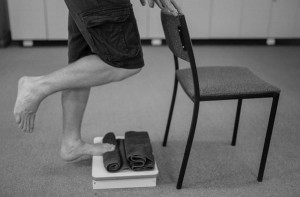 In our first book on this condition, FitOldDog’s Plantar Fasciitis Treatment, step five of our approach included a number of exercises, especially single calf raises. Since then, a Swedish study demonstrated the value of the single calf raise. Exercise is clearly critical for fixing plantar fasciitis in the later stages of recovery. However, too much exercise, or the wrong type of exercise, too soon, might well make things worse, so explore this slowly and carefully, is our advice.
8.
I will soon be tabulating the data from the Plantar Fasciitis Stories to start making sense of things. LOTS TO DO. ***
Selected Research Articles On Plantar Fasciitis
Under construction (busy reading)
Before answering questions and proposed treatments, commercial and otherwise, let’s consider available research results, for which I have found only one article, so far, and now I’m busy looking (send them my way, PLEASE, to [email protected]).
High-load strength training improves outcome in patients with plantar fasciitis: A randomized controlled trial with 12-month follow-up. Rathleff MS et al., Scand. J. Med. Sci. Sports, 2014, August 21.
Found it in the New York Times, along with this comment. “Until recently, first-line treatments involved stretching and anti-inflammatory painkillers such as ibuprofen or cortisone. But many scientists now believe that anti-inflammatories are unwarranted, because the condition involves little inflammation. Stretching is still commonly recommended.”
So, that’s it for scientific research for now, onto personal observation and opinion, much of it FitOldDog’s.
Single leg calf raises were found to help in the recent study referred to above, where other standard treatments didn’t. Interestingly, this is part of step five of FitOldDog’s Plantar Fasciitis Treatment, which we published in November, 2013, in video format. Must be psychic?
The scientific confirmation of our approach was encouraging, but remember, when it comes to plantar fasciitis, one size does not fit all, as there are a wide range of causes, and it comes in many formats. Which is why this subject interests me so much (plus, I’ve had it twice, one minor and one horrible).
You can find our videos for only $2.95 at this link, though they will be much improved within a few months.Important Note: These posts do not provide medical advice. You should always consult your physician before undertaking or significantly modifying an exercise program.
Copyright © 2010 Kevin T. Morgan aka FitOldDog, Old Dogs in Training, LLC.




Speak Your Mind