Here you see a much younger FitOldDog (right), with his colleague, Dan, back in the early 1980s, studying mucociliary function - been a splitter all my life, and felt that I had come home when I entered research. Now for the pathogenesis of plantar fasciitis (osis? ??). Click image or this link to watch our old mucus movie. Still a good one!
path·o·gen·e·sis ˌpaTHəˈjenəsis/ noun MEDICINE
- the manner of development of a disease.
There are two kinds of pathologists, lumpers (best for generating effective tables for further statistical analysis) and splitters (more suited to basic research and NOT for generating useful tables; they complicate and question everything too much, but they can guide the focus of the lumpers, if they approach the issue with tact and diplomacy - not my strength).
FitOldDog is a splitter. Not better than a lumper, just different.
Let’s take a splitter’s approach to where plantar fasciitis-related pain occurs, for a start; and it moves around, by the way. Remember, you can’t do effective pathology without a precise understanding of anatomy, amongst other things.
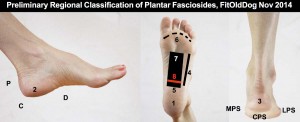
Key: 1 = sole of heel, 2 = medial heel, 3 = posterior heel (proximal insertion), 4 = lateral margin of sole, 5 = posterior margin of sole of heel (‘central’ or posterior distal insertion point), 6 = anterior extremity of plantar region (distal distal insertion points), 7 = diffuse plantar region of sole, 8 = zone of tearing (I felt this once, never again, please!). P = proximal with respect to long axis of the body from the head, C = central region of the heel, D = distal with respect to the long axis of the body from the head, MPS = medial parasagittal, CPS = central parasagittal, LPS = lateral parasagittal.

Here is Walter Fraser, a great supporter of our efforts, and first responder to our research newsletter. Thanks so much, Walter - for his full plantar fasciitis story go to this link.
I decided that it was time for ‘plantar fasciitis revisited’, and with an open mind (I try to do that, but I don’t always succeed - just ask the women in my life!).
The funny thing is that the pain and other sensations (it’s not just pain) can move around, come and go in moments in response to how you sit, walk or run, and has a different feeling in each location. For instance, on the bottom of the heel at location CPS1 (see map), it has a deep-seated aching component, at CPS8 there can be a searing, almost burning feel to it, LPS4 feels to be under tension, and at MPS6, CPS6 and LPS6 the feelings are generally a vague pulling sensation with only a minor pain component (in my experience). They all involve some degree of pain, but it’s not just pain!
Does this really matter? It does if you are trying to work out what is going on, as you never know where the critical clues might lie.
For instance, take this first confirmation (of which I’m aware) of my observation of the tendency of the pain to migrate around the foot, in response to one’s activities or treatment. This quote is pulled from our first detailed plantar fasciitis research story, kindly provided by Walter Fraser, an avid runner:
“Whether as a result of the cortisone kicking in late or possibly a combination of the whole spectrum of things I was using the symptoms moved away from the ball of the heel to the outside edge of the my foot (lateral PF).”

Rebecca laughed when I told her I had plantar fasciitis again. She said “It’s is a great opportunity” - little did I know how right she was. I’ve learned a bunch. Selfie by FitOldDog, with permission.
Walter’s pain had migrated from CPS1 to LPS4; finally some tentative observational precision in the study of so-called plantar fasciitis.
Such precision is critical in research. For instance, histopathological precision with respect to the recording of lesion distribution, played a major role in our determination (took about 12 years) that nasal lesions induced in the upper airways by irritant gases are almost certainly a consequence of local boundary conditions in the gas phase - see this link.
If we don’t really understand the pathogenesis of plantar fasciitis, though we are aware that it hurts, it is time to study it further. Such study is the goal of our Plantar Fasciitis Research Newsletter, and useful data are already coming in - please add yours!
We seek plantar fasciitis stories to improve our understanding and guide research. For instance, it is assumed, it would appear, that plantar fasciitis is an inflammatory condition (thus the ‘itis’), and that it involves microtears in the plantar fascia.

After a 2 month battle with my second case of plantar fasciitis, I am finally back running my favorite trails, pain free - carefully does it, following the 10% rule.
I couldn’t find photographs of these microtears on the Internet, and furthermore, my plantar fasciitis symptoms are not consistent with such a condition. I did, however, find a great (pro)fascia site at this link, and another saying that all this fascia stuff is dubious at best.
I am extremely fortunate to have suffered my second case of plantar fasciitis, it is teaching me a great deal, as are the stories generated in response to our Plantar Fasciitis Research Newsletter (sign up at this link).
Initial and tentative conclusions from this research: so-called plantar fasciitis, in the early stages at least, contains a significant neural, probably proprioceptive, component, which may interfere with normal biomechanics sufficiently to trigger subsequent, more harmful effects, such as heel spurs, plantar fascial rupture, and the end of your running, of course.
Important Note: These posts do not provide medical advice. You should always consult your physician before undertaking or significantly modifying an exercise program.
Copyright © 2010 Kevin T. Morgan aka FitOldDog, Old Dogs in Training, LLC.
Related Posts
- 92Stand in the center of the circle, spin around, and you see all those treatment choices. Our goal is to simplify this process. If you are interested, go to this link to see some plantar fasciitis journeys, mapped on this diagram. To understand a disease you need to study it and look for patterns -…
- 84I think that I am correct in saying that no-one, absolutely no-one, really understands so-called plantar fasciitis (fasciosis?). Plantar fasciitis isn't a condition, it's a complex of different conditions, leading to similar symptoms. Some things are known about this painful condition, but there are many different treatments, some of which work for some people and…
- 80Our understanding of plantar fasciitis is changing all the time, so the purpose of this page is to extend the road map as laid out in our book, as books are out of date before they come out. Fortunately, the Internet permits immediate updates in the form taken here. All customers will receive a copy…
- 79Why would I say that my plantar fasciitis heel pain could be my friend? Because it was a warning bell, indicating bigger trouble yet to come if I didn't address the issue. Yes! Pain can be your ally, though that is not always the case. When I told my co-author, and body movement teacher, Rebecca,…
- 77This page is all about people - the companion page is about data Our goal is to inspire others with your stories! To be on this page we'll need your plantar fasciitis road map, which can most easily be generated by sending the steps you followed to fix your foot/heel pain. Just send it as…





Speak Your Mind