
Hi folks,
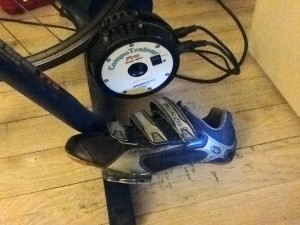
CompuTrainer drive module next to my favorite old bike shoe.
Today my coach-scheduled workout was a four hours and thirty minute Z2 (heart rate around 112) bike ride, but the weather was too cold for this ‘old fart,’ so I decided to do it on my trainer. This is a long time to be on a trainer bike, and as I don’t think that listening to music is a good idea because you generally aren’t listening to your body when you do that, I had plenty of time to ponder. My thoughts drifted towards my CompuTrainer and my bike shoes. I can use the CompuTrainer to analyze my spin quality, but I also like to employ my bike shoes for this job, as they are available on the road where I prefer to ride. So, how do you use your bike shoes to analyse your spin? It’s simple! You watch what is going on.
The goal of an ideal spin is to recruit different muscle groups with an optimal pattern in order to propel the pedals with minimum effort or maximum effect. You recruit each required muscle group sequentially during the spin cycle, as is nicely explained in the diagram by Rob Muller. But how do you know which muscle groups are being activated in order to improve your spin skills? The answer lies in the pressure on the pedals, which can be down (quads), back (gluts and hamstrings), up (hamstrings and hip flexors) and forwards (hip extensors). CompuTrainer output comes as nice graphs on a computer screen, and you will immediately see your areas of weakness. However, it is difficult to take this device out on the road, which is where your shoes come in. With a high quality spin your feet will lightly float around inside of your shoes, in a kind of circular pattern. If you skip a spot then you are missing muscle activity that can help your progress along the road. The commonest area of neglect, according to Victor (Bicycle Lab), and it was true in my case, are the glutes. These are the largest muscle group available to you for cycling, even larger than the quads surprisingly. When these muscles are activated your heels will push into the back of your shoes.
Next time you are on the bike watch how your feet move around inside your shoes, and if you miss a place this is where you should slowly (and I mean slowly) work to activate the neglected muscle groups. You’ll be surprised by the effect this has on your riding, especially for fast acceleration and hill climbs.
Don’t listen to music on your trainer, listen to your feet.
-k @FitOldDog
Today’s workouts:
| WorkoutPLAN Coach: Chris Hauth |
 Bike |
| Duration: 04:30:00 |
| Description: Steady Z2 ride |
Important Note: These posts do not provide medical advice. You should always consult your physician before undertaking or significantly modifying an exercise program.
Copyright © 2010 Kevin T. Morgan aka FitOldDog, Old Dogs in Training, LLC.
Post Footer automatically generated by wp-posturl plugin for wordpress.




I only agree up to a point. Sometimes you just have ride. Become one with the bike. Don’t separate yourself from it by thinking too much…
I agree with not thinking too much, but I sure find that hard to do. -kevin