Hi folks,
Yesterday I started on Victor’s squat diet. Having an abdominal aortic aneurysm with a stent graft, I took a cautious approach, only carrying my squat down to the point where my knees made a 90-degree angle. I was also careful to use good form, pushing out my butt with a straight spine and a firm (but not rigid) core, whilst keeping my shins fairly close to vertical to the floor. During three sets, I increased the weight until I was unable to complete 12 reps safely, as instructed by Victor.
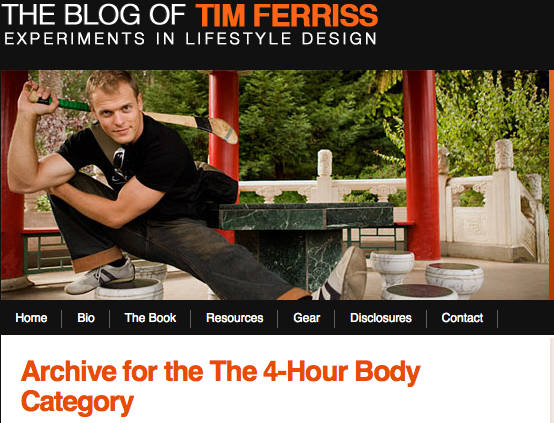
The Four Hour Body is well worth reading. From: http://goo.gl/ZFeD2
This approach is all about intensity, as opposed to volume, an issue that is discussed nicely in the latest book by Tim Ferriss, ‘The Four Hour Body.’ Squats are great for your quads, gluts, and core. The core muscles provide stability, which is essential for safety during this free weight exercise. Victor swears by free-weight (straight bar) squats for cyclists. I am going to see how it goes. Of course, the next day I was sore in a number of places.
Soreness after workouts, with respect to both location and nature, can be highly informative. For instance, the day after this workout I had mild discomfort in my glutes and quads, meaning that I had hit the muscles intended for strengthening. I had more severe soreness, however, in my adductors, especially the left ones. I have chronically weak adductors, which was diagnosed years ago by a physical therapist. This may turn out to be a limiting factor for me in during this exercise, or it might indicate that I need to change my stance slightly, or undertake some extra work on the adductor machine. It will be up to me to watch this carefully and decide as I become more comfortable with this routine. Here is an excellent video (via YouTube) from Alex Poole Fitness, showing ideal squat technique.
I also noticed soreness on the tops of my shoulders, but this was due to the pressure of the metal bar, suggesting that a towel around the bar might be needed. As an aside, I suffer soreness in the same location, but confined to the left shoulder, towards the end of long runs. It is a burning sensation in muscles near the surface of my skin. I attribute this response to tension in my left shoulder region, inducing unnecessary tension that probably slows me down. This is an example of soreness sending me a valuable message. I’m still trying to work out how to fix it; I just have to unravel the message.
Another common cause of avoidable soreness is poor running style, an issue addressed in the movie below, put out by The Feldenkrais Institute. Again, I don’t make money from Feldenkrais (the reverse is true, I pay for training), but I really think it has done more for my sport than all other things combined.
So, when you are sore after a training session use the information that your body is providing to (1) improve your technique, (2) detect imbalance or symmetry issues that need addressing, (3) estimate recovery time required, or (4) predict the potential for more serious injury. Thinking carefully about such observations may save you big trouble down the trail.
-k @FitOldDog
Important Note: These posts do not provide medical advice. You should always consult your physician before undertaking or significantly modifying an exercise program.
Copyright © 2010 Kevin T. Morgan aka FitOldDog, Old Dogs in Training, LLC.
Post Footer automatically generated by wp-posturl plugin for wordpress.