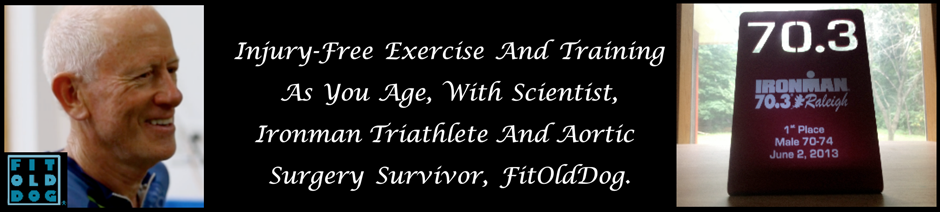
Hi folks,
The real trick to a happy and productive life, in my opinion, is to question the obvious, which includes your own opinions, naturally. I often read articles stating that older people (articles for 50+, 60+, rarely 70+, and almost never 80+) slow down, need to take greater care of themselves, and require more recovery time after exercise. Are these observations correct? How does one find the right test and control groups to compare?
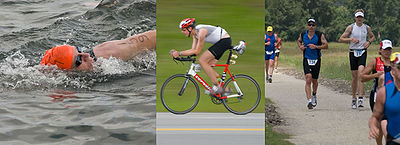
Triathlon! I continue to enjoy this sport at the age of 68, and I plan to for a long time to come.
I meet guys at Ironman races who are in their 70s and 80s who could drop most men under 40 in a run exceeding five miles, unless the latter group was given time to train for the race. We definitely slow down as we age, but do we need to slow down THAT much? I completed the Boston Marathon at the age of 67 in four and a half hours, whilst the first person in my age group finished in three hours and six minutes, which is fast for anyone. So! Do we need more recovery time if we are in good condition?

Joe Friel's Blog. Where I go for thoughtful analysis of approaches to training and exercise.
One place I go for thoughtful answers to such questions is Joe Friel’s Blog. Here for example is his discussion of performance decline with age in shorter versus longer events:
“Why would Ironman athletes get slower as they aged at a greater rate than their age-related counterparts at the Olympic distance? Of course, what the researchers did here was to compare the split times of, let’s say, 50-year-olds with those of 30-year-olds at the same distance and then compare the rates of decline for the corresponding Olympic and Ironman age groups. The short-course triathletes slowed down the least.
Here’s my take on this. The primary determiner of performance in short-course racing is intensity. These athletes are likely to do very fast-paced intervals to boost performance. For the Ironman-distance the primary determiner of performance is duration. They are likely to do long, steady workouts at a much lower intensity. If that’s true, and I believe it is, then it seems to point the finger of blame for loss of performance with age at training intensity rather than duration. If you train slower, albeit longer, you are likely to lose performance at a greater rate per decade than if you train fast with perhaps fewer miles.”
Joe wrote a series of articles on the effects of aging in athletes. Here is the link to the first one, and you can scroll forward in his blog to see the rest. Joe has plenty to say about recovery, and here I quote from another of his posts: “Recovery should be built into every day, every week, every month and every year. For some this is the hard part. This is where they fail on the path to high fitness.” As older, and hopefully wiser, athletes perhaps we should avoid this pitfall, but often we don’t. And here, finally, is what I found on the effect of aging on recovery, and again I quote from Joe’s blog: “At age 20 I could bounce back and do this workout day, after day, after day. Now I might be able to occasionally do two of these sessions in a week. One is more likely. I simply couldn’t spring back. There’s no question that aging impacts recovery.” FitOldDog’s advice is that you listen to Joe Friel’s advice on this matter.
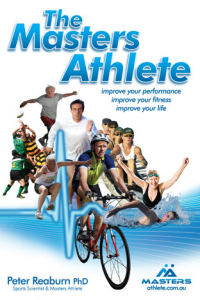
Full of useful information.
Next question is how much should we adjust our training or exercise program to compensate for this aging effect?
Here I turned to The Masters Athlete, by Peter Raeburn. The book does not have an index, and the website does not appear to have a search function, so I left cyberworld and found my copy of his book. Great advice on the effects of aging, and a nice chapter on recovery. Here is the sentence I liked, from page 222: “Recovery is specific to the individual. Just as individuals respond to physical or psychological stressors differently, so also do different athletes respond to different recovery strategies. Try them, evaluate them, and then hold onto the ones that suit you and your lifestyle” [sounds just like Bruce Lee!].
Finally I consulted someone who really knows about being an older athlete, Earl Fee, and his book, ‘The Complete Guide To Running: How To Be A Champion From 9 To 90.’ The section on recovery for older athletes in this book is very succinct. “As you age, recovery becomes more important. More rest is required to prevent injury and burnout.” He then provides a lot of information on approaches to recovery. An excellent book.
So there you have it:
- Recovery takes longer as you age.
- Find what works for you and use it.
The obvious is obviously correct in this case, but is that true in your case?
-k @FitOldDog
Important Note: These posts do not provide medical advice. You should always consult your physician before undertaking or significantly modifying an exercise program.
Copyright © 2010 Kevin T. Morgan aka FitOldDog, Old Dogs in Training, LLC.
Post Footer automatically generated by wp-posturl plugin for wordpress.







Increased recovery time has certainly been true for me as I age. After a while it wasn’t just a matter of finding time for my workouts, but also finding time for the extra sleep and rest that the workouts required in the days afterward. It’s taken me several years and a heightened attention to my body’s signals to find the zone where I can push myself without overdoing it.
Hi LeeAnn,
Thanks for the comment. Yep! You, me and Joe Friel all say the same thing. We need a little more time. I think the real trick to enjoyable training as you age is to avoid injuries. I like your blogsite http://goo.gl/sPocA, by the way, and I really liked the picture of 100-year old Ruth doing Pilates http://goo.gl/t7HmT that you sent out via Twitter http://goo.gl/ZSgKZ. Way to go, Ruth.
-k @FitOldDog
Hi Joe, this is the old nature versus nurture issue for physical ability. I agree that genetics plays a big role, as does nutrition during childhood and adolescence. Being born during a war my body has some issues related to that. War sure is bad for kids. That said, we can do our best with what we have. I recommend that everyone work out to the best of their ability what their personal limits might be, in order to avoid injury. Sure had my share until I wised up. I certainly appreciate your comment. I suspect that my genetics has played a role in my inability to cope with barefoot running, but I did give it the old college try. Thanks again for your comment. Cheers, Kevin