
Hi and thanks for coming by!
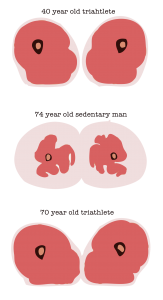
Artist’s rendition of image from a publication on the atrophy of mid-thigh muscles due to inactivity. Muscle is red and fat is pink. Figure by Duncan Morgan. Click image for original article.
 Staying fit really changes your life, my friends. I watch people my age having trouble getting on a bike or tying up their shoelaces, and I wonder. Why do they do that? Just one look at the adjacent figure, adapted from a scientific publication on muscle loss in sedentary older people versus triathletes young and old. One glimpse should be enough to wake them up - a picture is worth a thousand words. Thank goodness I am lucky enough to enjoy exercise. Yes! I actually enjoy exercise, and fitness is just a byproduct. I suspect that most people want to be fit, whilst many do not actually enjoy the process needed to get them there. This must be very frustrating, but I guess it all comes down to phenotypic variance (we are all different for good evolutionary survival reasons). One of my ways of staying fit is to swim. I thought that I would share my favorite pieces of swimming advice that I’ve received on the subject over the years. Maybe this will get some of those people moving again - in fact, if you are really out of shape the pool is probably the best place to start your program of safe exercise for better health.
FitOldDog’s Favorite Swim Tips For Beginners:
- The first things to master are balance, breathing and relaxation, which can be achieved by following the Total Immersion Program.
- Next you need some understanding of optimal technique, and one of the best places to see this in action is to watch Mr. Smooth on the Swim Smooth Site, in Australia. You can also learn from swimmers on YouTube. There are many other great websites out there, such as The Holistic Triathlete.
- “Once your stroke isn’t all hacked up, it’s 95% conditioning and 5% technique” Rick Fee (my great new swim coach).
- “Lay on your arms.” (Mel Stewart three times gold medalist swimmer - he knows how to swim, I suspect) - this really works, once you understand what it means. Thanks a million, Mel!
-
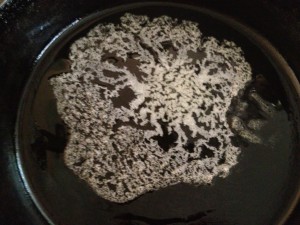
Butter melting in a pan demonstrates both fractal patterns and emergent behavior. Photo by FitOldDog
The greatest challenge is getting out of bed and into the pool in the morning, but once you emerge from the water your breakfast will taste ten times as good (personal observation).
- It doesn’t matter what your stroke looks like, it only matters how well it works (heard that on the radio).
- “Roll your shoulders in to lift your elbows high for better traction during the power stroke” (Chris Hauth, Ironman coach).
- You can only focus on one thing at a time, which is frustrating when you have about 20 things to fix (personal observation).
- Posture, position in the water and nutrition are all important variables for the long-distance swimmer, plus a wetsuit if the water is cold (personal observation).
- During the recovery stroke, throw your arm forward, like a whip, as you want it out of the water for as short a period of time as possible - remember Archimedes Principle - and sneak through the water (Chris, swim coach at a local pool, who coaches anyone for free as he just loves coaching).
- Be careful that you don’t become dehydrated in the pool, as this can happen, while you are completely unawares, and it is dangerous (personal experience).
- Don’t give up - that’s pretty obvious, as anyone can be a great swimmer if they master the basics and then work on conditioning (personal opinion).
Happy laps.
-k @FitOldDog
Important Note: These posts do not provide medical advice. You should always consult your physician before undertaking or significantly modifying an exercise program.
Copyright © 2010 Kevin T. Morgan aka FitOldDog, Old Dogs in Training, LLC.
Post Footer automatically generated by wp-posturl plugin for wordpress.





Hi Kevin,
very good article.
Tnx.
M.
Hi M, I really appreciate the encouragement, it’s much appreciated. -k
Hi FOD. I love swimming; back in the day, could do laps and laps and laps. A few days ago, finally got back to the lap pool (from the ‘leisurely swim’ pool). Just did 15 careful minutes, and different strokes, plus what I thought were gentle pull-ups using the blocks at one end of the lane. Something/all I did gave me inflamed deltoids, maybe injured rotator cuffs, both arms. Took a few days and a pain pill or two plus ice to reduce the pain. Going back to the pool though. Love it.
Start easy, remember the 10% rule, and you’ll be cruising before you know it. Don’t strain a rotator cuff - try rotating your shoulders in towards your mid-line, as that helps. Also, try to swim from your core instead of your limbs, as this is the way to avoid strain. -k
Great summary, thanks for the shout-out.
As a coach as well as a swimmer this is one of the biggest challenges:
You can only focus on one thing at a time, which is frustrating when you have about 20 things to fix (personal observation).
Patience goes a long, long way in swimming.
Yep, patience is the key. I find that each thing I work on becomes slowly incorporated into my overall stroke. In fact, it will sometimes come as a pleasant surprise that my elbow actually is high and I wasn’t thinking about it. Thanks for following. Kind Regards, Kevin