
Hi folks,
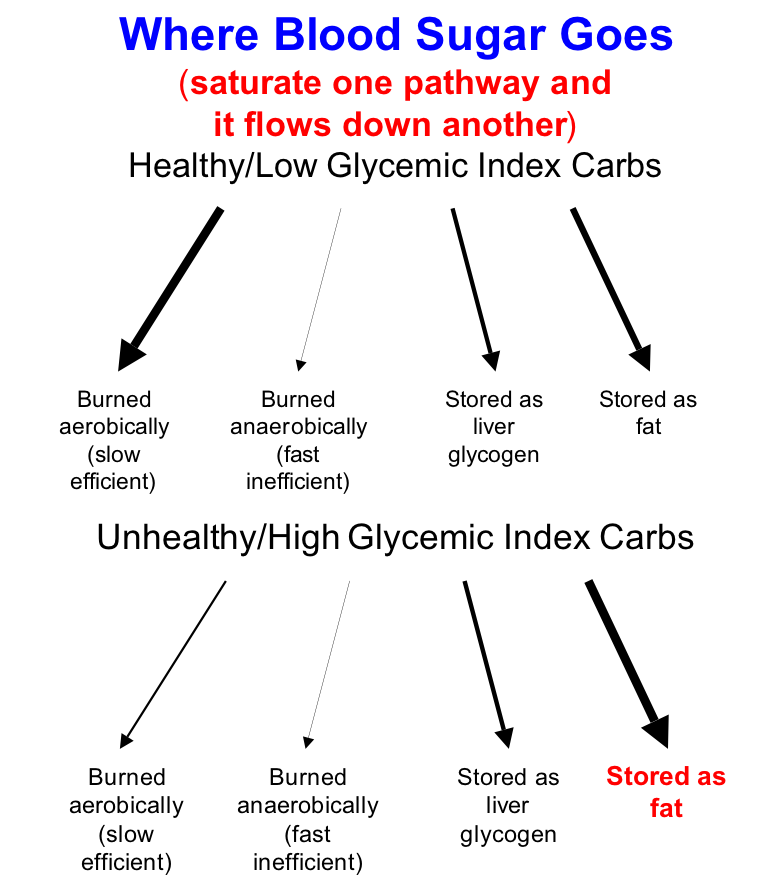
Once you understand where blood glucose goes in response to rate of delivery you’ll take glycemic index (GI) seriously. From: FitOldDog’s Head
Every now and then I sign up for an RSS feed to my e-mail account, and then forget all about it. One came into my spam account today (which I check carefully before deleting), see below - a little long, but very interesting. First take a look at my little diagram (right), which explains in a simplistic manner the influence of rate of entry of glucose into the blood upon it’s final destination. High glycemic index (GI) foods are rapidly broken down to enter the blood as glucose and flood all exit routes, increasing blood insulin, which encourages storage of sugar (glucose) as fat. This is a gross simplification of a complex and dynamic flux field called general metabolism, and if you are really interested, which you should be if you are serious about exercise and health, buy yourself a copy of Harper’s Biochemistry, to read quietly of a winter’s night.
RSS feed to my email today:
GI News <http://ginews.blogspot.com>
Wednesday February 1, 2012
In this issue of GI News: <http://ginews.blogspot.com>
Smart carbs for smarter kids?
A recent UK study found that kids who ate a low GI/higher carbohydrate breakfast completed set maths tasks faster and more accurately and
improved their general reasoning skills and their overall attentiveness than kids who ate a high GI breakfast ' ...Read More »
<http://ginews.blogspot.com/#GISP>
Do refined wholegrain foods make a difference?
'The reality is that for most cereal products today, both the white version and the brown version have a high GI' says Prof Jennie
Brand-Miller. 'I'd like to suggest that we re-define wholegrains as "foods that not only containthe germ, the endosperm and the bran, but also the GI characteristics of the original grain". Atleast then, we might see some real benefits of eating them.' ... Read More »
<http://ginews.blogspot.com/#wholegrains>
Slowly digested carbs reduce inflammation associated with chronic disease 'When it comes to reducing markers of chronic-disease risk, not all
carbohydrates are created equal. Quality matters,' says Dr Marian Neuhouser RD. 'Whenever possible, choose carbohydrates that are less
likely to cause rapid spikes in blood glucose' ... Read More »
<http://ginews.blogspot.com/#inflam>

If you want to watch your weight or be the best athlete that you can be, you had better understand glycemic index. From: http://goo.gl/Un0tW
8 myths about sugars and starches dispelled Prof Jennie Brand-Miller dispels some perennial myths including starchy foods such as potatoes and pasta are fattening and sugar causes diabetes... Read More » <http://ginews.blogspot.com/#JBM>
Are brown foods better for you than white? 'It would be nice if there was a simple colour rule for healthy eating' says Nicole Senior, 'but there isn't ... Read More »
<http://ginews.blogspot.com/#Nic>
The scoop on barley Emma Stirling explains how you can embrace low GI pearled barley in your
cooking ... Read More » <http://ginews.blogspot.com/#es>
Three low GI recipes to try Broccoli with orzo soup, Brown rice & barley salad with spiced chickpeas, sweet potato and currants and Aubergine, potato & pepper stew
... Read More » <http://ginews.blogspot.com/#kitchen>
Footer <http://www.glycemicindex.com/blog/footertail.jpg>
Forward to a friend to SUBSCRIBE
<http://www.glycemicindex.com/subscribe.htm> to GI News. Not interested
anymore? Unsubscribe <http://www.glycemicindex.com/unsubscribe.htm>.
©2012 Glycemic Index Research. All rights reserved. The University of Sydney, Australia.
I recommend that you learn a little about glycemic index, which incidentally was a subject of extensive study by Tim Ferris, of ‘The Four Hour Workweek’ fame and one of my personal heroes. Look at the many sites related to this subject, and then you will understand why not all carbohydrates are created equal.
-k @FitOldDog
Today’s workouts:
| Workout PLAN Coach: Chris Hauth |
 Bike |
| Duration: 01:30:00 |
| Description: up to 2 hrs. - nothing hard here - just steady Z2 cycling |
 Swim |
| Duration: 01:00:00 |
| Description: 3000 - 400 warm up - 24×100 - 8×100 with 30 sec. rest stretch out and some drills, 8x 20 sec rest add some stroke, 8x 10 sec. rest - steady, solid freestyle. 200 warm down |
Important Note: These posts do not provide medical advice. You should always consult your physician before undertaking or significantly modifying an exercise program.
Copyright © 2010 Kevin T. Morgan aka FitOldDog, Old Dogs in Training, LLC.
Post Footer automatically generated by wp-posturl plugin for wordpress.







We are a couple in our early 60s interested in a low GI diet. Two members of my husbands immediate family have type 2 diabetes. He has lost 9 kilos in the last couple of weeks and is probably still about 10 kilos overweight. I want to lose about 3 kilos. He will walk the dogs with me but I do quite a bit more exercise than he does. We would be interested in low GI information and recipes. I notice you can still eat sugar on the diet and wonder how this affects weight loss. Should we be following a low GI, low sugar and fat diet? Need help as we are still a little confused. Thankyou, Lynette and Colin Ross.
Hi Lynette and Colin,
this reply is written in a state of severe jet lag so it is rambling. I always get it on my return to the US from Europe.
Rambling:
1. Glad you asked about this issue, which is complicated, interesting and important. I think there are a number of things to remember, the major one of which is dynamics, or how things happen with time. It is often not what you do, but how fast you do it.
2. The GI of a carb source tells you how quickly it becomes simple sugar, namely glucose in the blood, which will trigger insulin release and a tendency to store this sugar as fat. For the endurance athlete, GI is important because too rapid a surge of glucose in your blood will cause an insulin spike (rapid increase) and then an undershoot of blood glucose, which will cause you to bonk (become dizzy and nauseous) due to transient low blood sugar - this is dangerous for us because if we vomit we lose precious fluid and electrolytes, and that create a dangerous feed back loop.
3. Biology is all about the rate at which things happen.
4. I’ll write a blog post to try to clarify this issue, if that would help, and I’ll find you some other resources. I will include your comment in the post, as from you and linked to the comment but ONLY if you approve.
5. I do have a book on exercise for diabetics that I was planning to read and then write a review, so maybe I could do that sooner rather than later.
6. When it comes to low sugar or low fat diets, this is a complicated issue laden with special interests and confusion. I reviewed an interesting book on this by Gary Taubes a while ago (just search my blog for his name, which will take you to the link on another site that deal with diet).
7. Let me write a short post laying out the variable and points of confusion - and we will see if that helps.
8. RULE NUMBER ONE WITH YOUR BODY - make all changes slowly. It is the reason cramming for an exam doesn’t work long term, and why you must lose weight slowly and steadily. Increasing exercise levels must also be done slowly. Exercise and the right diet can fix the T2DM problem, I’m pretty sure, but it takes time, understanding, and learning how YOUR body responds. One size does not fit all, so body awareness is key.
I’ll work on this.
So:
- Change things slowly.
- Low GI foods best for the T2DM issue, and there is lots of info on the web.
- Ramp up exercise slowly, and pull your man along with you if you can.
- Find joy in the process, but be disciplined too, and you’ll both do well.
Thanks for asking as this is what my blog is all about. Helping people.
Kind Regards Kevin aka FitOldDog