“According to Ayn Rand, the choice we make is not whether to have a philosophy, but which one to have: rational, conscious, and therefore practical; or contradictory, unidentified, and ultimately lethal.”
Hi folks! Welcome!
 The central core of my surgery recovery philosophy, based on experience with an abdominal aortic aneurysm, is the risk-benefit assessment. This assessment ultimately has to be carried out by you, the patient. Here, I attempt the development of a quasi-quantitative approach to help clarify one’s thinking, when thinking is not so easy due to the emotional pressures of a life-threatening situation.
- Only you know how much value to place on certain activities, including sports – the benefit.
- Only you live in your body and thus can truly assess the stresses and strains associated with your chosen activity – the risks.
The benefits must outweigh the risks.
There are several ways to approach your return to life after aortic or other life-threatening, and thus life-saving, surgery, as follows:
- Denial - let’s not think about it.
- Ask the doctor - give your decisions away to a ‘higher power.’
- Think it through carefully and wisely with all the input you can get – mature approach.
 People ask my advice on this issue from time to time. Here are some examples:
- How should I approach exercise following an aortic dissection repair, as I want to get back in shape?
- Can I play golf with a 4.2 cm. ascending aortic aneurysm?
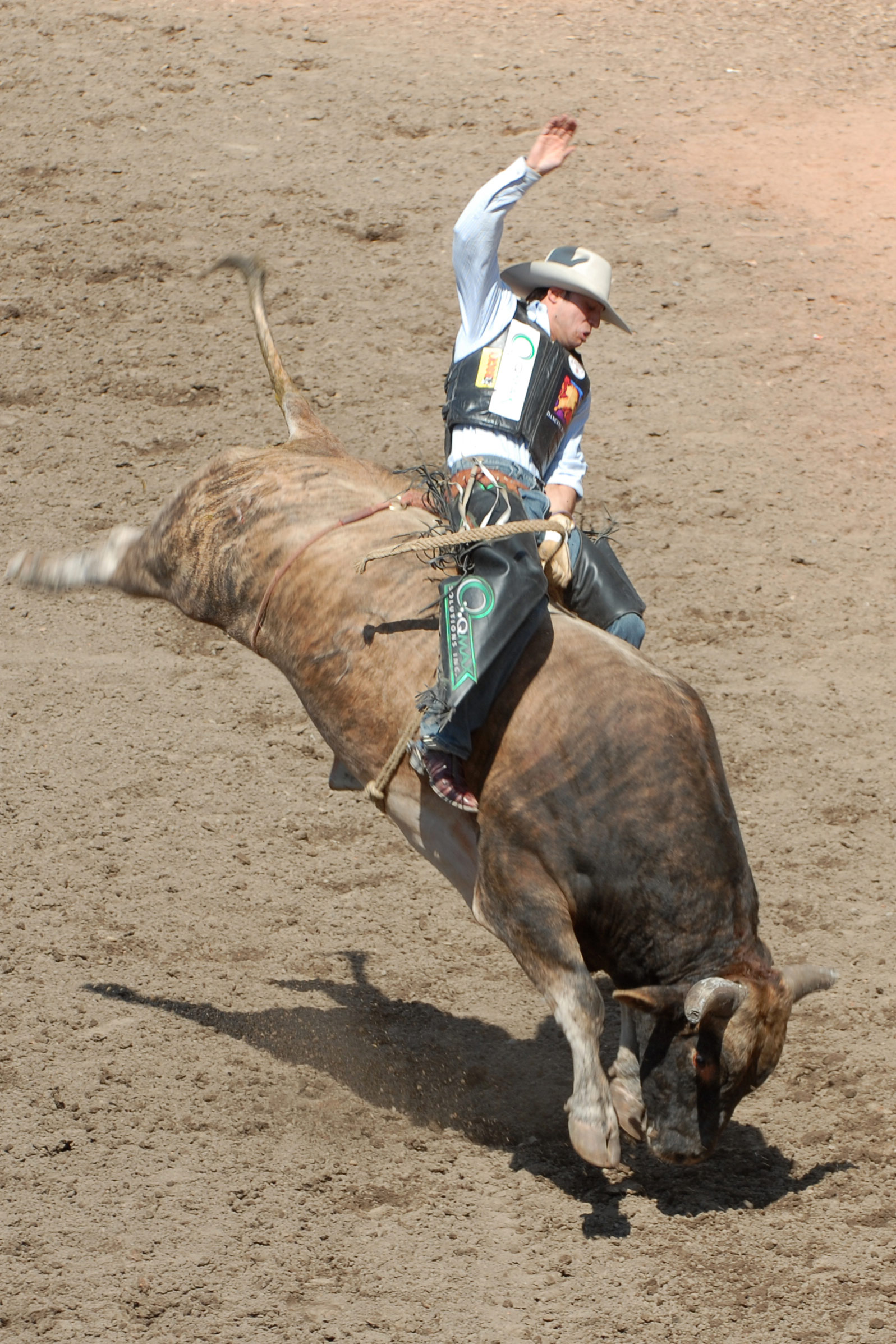
- Is it OK to ride a mechanical bull with Marfan syndrome, a genetic connective tissue disorder that is associated with aortic fragility amongst other things?
- Can I compete in ultra-marathons with a 3.4 cm. abdominal aortic aneurysm?
- Is it safe to run marathons with a 3.8 cm. abdominal aortic aneurysm?
- Is it safe to have sex with an abdominal aortic aneurysm?
- Can I go back to heavy weight lifting following my aortic dissection repair?
- And finally, my question: is it safe to compete in Ironman triathlons with an abdominal aortic aneurysm stent graft?
Let’s consider a few of the examples, with the goal of developing an approach that facilitates clear thinking about the issues.
Can I play golf with a 4.2 cm. ascending aortic aneurysm (Alan)?
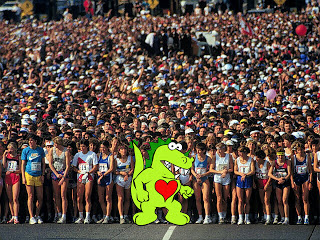
Team Heartosauras for the American Heart Association at the New York City Marathon 2012, created by Benjamin Carey.
My immediate reaction was “Not a good idea!” Why did I say that? Because the drive stroke in golf can involve considerable torquing or twisting of the chest cavity (thorax) and thoracic spine, right next to the ascending aorta. Do you really want to be twisting and turning structures adjacent to the aneurysm? Probably not! So I called Alan to get more information (great guy), and here is how I would do my risk-benefit assessment if I were Alan, starting with benefit.
Benefit? It turns out that Alan is not just the average golfer, he is a serious competitive golfer who loves the sport. It is a big thing in his life. To be able to continue playing, knowing it is safe to do so, is critical for him. Benefit = 0.8 (0 = no real gain in life quality; 1 = can’t live without it).

Highly recommended reading by FitOldDog. Benjamin Carey’s story about his open heart surgery and running the NYC marathon with his surgeon one year later.
Risks? Compared to assessing the benefits, determining risk is much more difficult, and ultimately it may only be possible to arrive at a rough estimate of risk. Let’s consider it from a number of angles, and develop a quasi-quantitative approach to clarify our thinking. (0 = no risk; 1 = bound to slay).
- What do the doctors/surgeons/cardiologists say? Nature of the surgery, and fragility of site, time since surgery with respect to adequate recovery, experience with similar cases. On the last count 11 endovascular surgeons/cardiologists said no problem in Alan’s case, and one (highly respected guy) said not a good idea (plus one veterinarian, myself, said the same). Score = 0.3
- What does the family say? Getting the input of your loved one’s, who will be scared but also cognizant of the degree to which you love golf, is critical. Score = 0.5
- What does your research say? First ask the surgeons, cardiologists and if possible researcher in the field, for an educational session, in order to fully understand your situation. Find someone with medical training to assist you in this process. Read about the surgery site, it’s development in the embryo, functions during life, anatomy, histology, effects of aging, and anything else that you can understand – this will help you to ask the right questions of your medical advisors. Look in the literature. Look anywhere for helpful information related to your risks. In Alan’s case, we were hoping to find cineMRI of the aorta during a golf stroke, but we couldn’t find any useful data, so let’s default to average risk value. Score = 0.5
Jerry had ascending aortic aneurysm surgery in February of this year, 2013, including a Dacron prosthesis. What would be a wise approach to endurance training in his case?
- What do your feelings say? Scared? Really want to play? Worried about my family? But I really want to play? Score = 0.3 (desire wins out).
- What can I do to reduce the risks? Modify golf stroke to use hips more than thorax? Play less? Focus more on putting than great drives? Multiply average risk score lower by 0.8 adjustment factor.
- Anything else that you can think of …
Then take all the information and attempt a wise decision. I like to quantitate in order to clarify my thinking (don’t think that these numbers will make your decision for you, they just help balance the variables), so I would determine the average risk (0 = no risk; 1 = certain death), multiply by the value of modifying behavior to reduce risk (in my case that included avoiding the rowing machine and deep squats in the gym). Then divide this value into the benefit.
My estimated assessment for Alan using this system (just devised), would be:
Risk = [(0.3+0.5+0.5+0.3)/4]*0.8 = 0.4
Benefit = 0.8
Benefit/Risk = 2
I would consider anything over a score of 1.5 to be a probable go ahead, but you might not. You might only be comfortable with a score of 5 and above, meaning lots of benefit and little risk.
Conclusion: if Alan really wants to play golf it is probably pretty safe to do so, but I would recommend careful exploration of stroke modification to reduce spinal twisting as much as possible. Again, it’s his call!
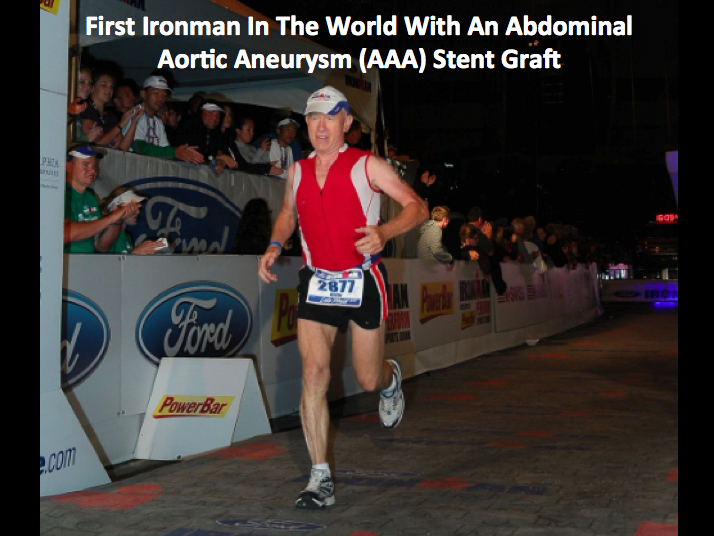
The author finishing the 2011 Lake Placid Ironman with an abdominal aortic stent graft. Click image for video.
Now let’s consider the case of Kevin and the mechanical bull:
Benefit = 0.9 (remember that a 1 = I’ll do it even if it will probably kill me).
Risk = [(0.9+0.5+0.6+0.3)/4]*0.99 = 2.9
Benefit/Risk = 0.3
Conclusion = I don’t care how much Kevin wants to climb on that bull, forget it!!!!
How about running marathons following aortic dissection surgery with a Dacron prosthesis (Benjamin and Jerry):
Benefit = 0.7
Risk = [(0.5+0.8+0.9+0.5)/4]*0.6 = 0.4
Benefit/Risk = 1.75
Conclusion: pretty safe as long as one develops a low impact running style. Jerry wants to go back to marathons, while Benjamin did it one year after his open heart surgery, with his surgeon. Was this wise? Who knows? We each have to decide for ourselves, as I say repeatedly.
This is a work in progress:
Proposed modifications: weight each of the factors based on relative importance - e.g. if family is a major concern, and they’re scared, whilst the doctors say fine, I would weight the family up - e.g. multiply by 1.1 to 1.5. I think I’ll explore this idea a little further, and convert it to a spreadsheet (App?).
Think it through my friends, using all the data that you can lay your hands on, and remember that life without risk is no life at all. That doesn’t mean one should take unnecessary or unjustifiable risks.
-k @FitOldDog
Important Note: These posts do not provide medical advice. You should always consult your physician before undertaking or significantly modifying an exercise program.
Copyright © 2010 Kevin T. Morgan aka FitOldDog, Old Dogs in Training, LLC.
Post Footer automatically generated by wp-posturl plugin for wordpress.






Thanks Kevin, all I can Say on my end is
Foreeeeeeeeeeeeeee. By the way during a live web chat with the Cleveland’s clinic two top Aorta surgeons I asked the question about playing golf. Cleveland clinic’s stance has always been not to play. Except this time they said yes, that I can continue to play golf at the 4.1-4.2 cm size.
Very good, Alan. Run the equations with your values, and if all is well (ratio > 1.5 for me), it will support your decison to continue playing, but this will then be based on more than just the opinion of physicians, who generally are not the best physicists, and if they are the best physicists they are not the best Biologists (who are also great Biomechanicians and Dynamicists; rare people). Your choice to play will also be based on the concerns of your family and the degree to which you love golf. Watch out for that 19th hole, it can be addictive, just like sports. I love the way you keep pushing to get answers from the Cleveland Clinic. They sound like great people. Wonder what they would think of v1 of my decision assistance nascent App? Cheers, Kevin